Communication is Key

September 29, 2025 | Karis Rodila, LPC, LMFT

Communication is Key

We’ve all heard the saying, “Communication is key.” I know I heard it many, many times when I was getting married. It’s the guidance you almost always hear when you ask, “What’s your advice for a good marriage?”  But what does this statement really mean? What makes communication healthy and effective in any relationship?  

Communication is Hard

I want to acknowledge at the outset of this blog post that communication is difficult, as is communicating about communication. Plus, there is so much to say – I won’t be able to cover all that you need to know in one article. The aim of this blog post is to give you a 10,000-foot view of some of the skills needed to have healthier, more effective conversations.

Tools for Effective Communication

Be Curious, Not Judgmental

I’ll admit that I was a little late to the Ted Lasso bandwagon, but wow! Since I’ve watched it, it has quickly become one of my favorite shows. Now why am I bringing up Ted Lasso in a conversation about communication? Because of a scene in Season One where Ted says a profound line: “Be curious, not judgmental.” Walt Whitman was the first to say it, but I always hear it in Ted’s Kansas drawl. 

Curiosity opens the conversation, while judgment is the surest way to shut everything down. When we feel judged by someone, we no longer feel safe to share the deeper parts of ourselves and our experiences. But when someone approaches us with curiosity, we have the space to open up, explore our experiences, and develop a stronger relationship with the other person. In the same way, our curiosity towards others helps us to be more emotionally regulated and protected against all-or-nothing thinking. 
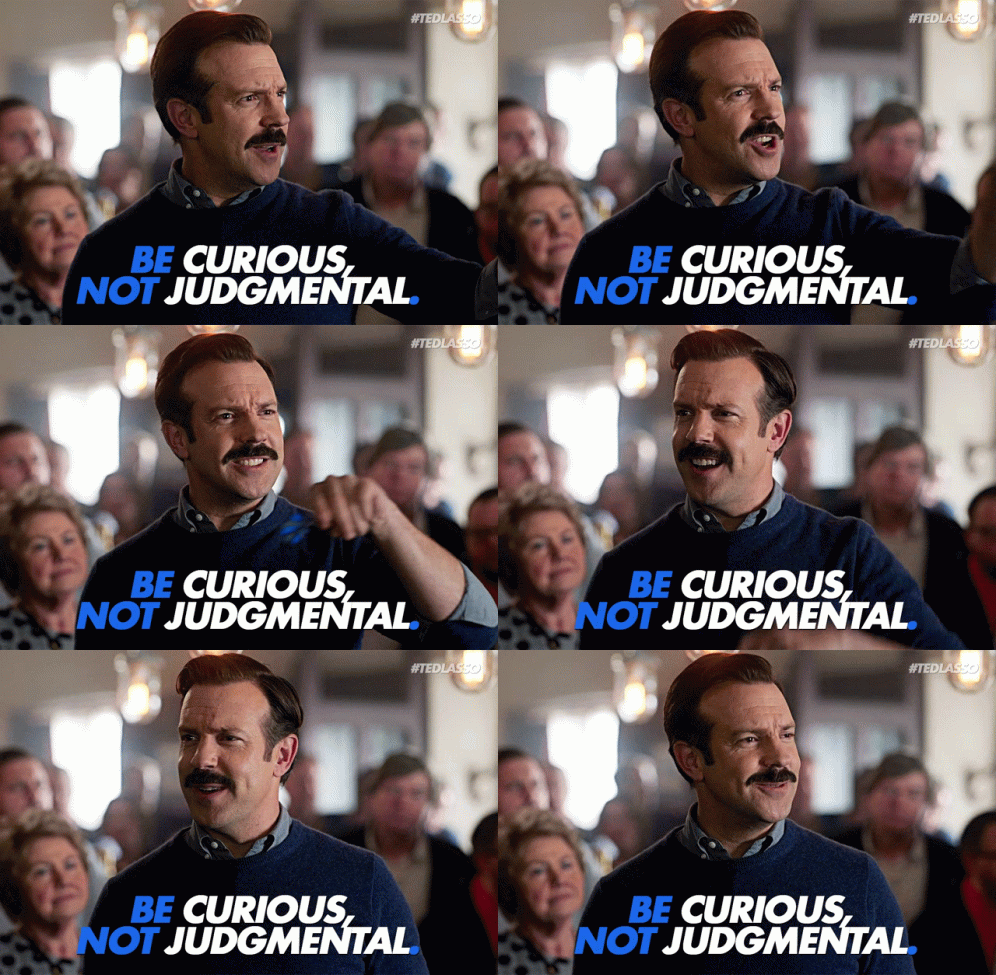
GIF: Ted quoting Walt Whitman in Ted Lasso, Season 1, Episode 8, “Diamond Dogs”, via AppleTV+

Curiosity in Action

Say a friend isn’t as responsive or engaged as they typically are. If I were in a judgmental place, I could make the meaning that I did something wrong and they’re mad at me. Or I could blame them, thinking that they are a bad friend. However, when I am seeking to practice curiosity, I like the phrase: “I noticed ______, and I wonder ______?” That could look like: “I noticed that my friend isn’t responding like they normally do. I wonder if there is something going on for them that’s getting in the way of their ability to be present with me?” 

From this perspective, I can then approach that friend from a calm, compassionate, and curious place. If you dig even deeper, you might realize that the message of being unimportant is significant to you. Perhaps, growing up, your dad was so busy with work that he was perpetually late to your baseball games, orchestra concerts, etc. You felt unimportant back then, and that was a painful experience, especially connected to your parent(s). Now, when people are late, it’s a button for you – you make meaning about their lateness. You translate it into, “I’m not a priority to you; you don’t really care about me.” 

Clear is Kind

My friend and I constantly tell each other, “Clear is kind.” This phrase means that we intend to be direct and explicit in expressing our feelings, experiences, and needs. In other words, we say what we mean and mean what we say. Being clear and direct ensures that we don’t fill in the gaps with our own assumptions. This helps to cut down on miscommunication and grows trust as we are transparent with each other. 

Healthy, “clear is kind” communication looks like assertiveness. Assertiveness is the ability to calmly and confidently state your opinion, belief, want, need, or experience. It is an empowered stance where you honor your thoughts, feelings, and needs. Bonus: it also gives the other person the best chance to understand your experience and meet your needs to the best of their ability. 

Passive, Passive-aggressive, and Aggressive vs. Assertive Communication

Unhealthy types of communication include passivity, passive-aggression, and aggression. When speaking aggressively, volume, tone, and the words chosen are meant to scare or force someone into agreement. Passive and passive-aggressive communication are both forms of indirect communication regarding your negative feelings or experiences. Passive communication often means a lack of talking about your feelings, experiences, or needs. This leads to a lack of authenticity. It could also be indicative of conflict avoidance or people-pleasing tendencies. With passive-aggressive communication, you might be trying to manipulate the other person into complying without being direct about your wants and needs. 

For example, say I wanted a friend or partner to prioritize time with me. However, I verbally lashed out and demanded that they change their behavior. With this approach, I am doing damage to the relationship. Conversely, if I use “the silent treatment” or passive-aggressive comments about the lack of time together, I am unlikely to get the response I desire. Why? Because the other person has little to no idea what’s wrong!

If I am clear and assertive about my desire for time together, I am more likely to receive the response I want. Assertiveness can look like, “I’ve been feeling a bit disconnected in our relationship recently, and I would like to spend more time with you. Could we take a few minutes to find a time that works for both of us and plan an outing together?”   

“Cue” Them In

Another tool that I really love when it comes to effective communication is the use of cue words or phrases. A cue word or phrase allows a lot of meaning without having to say or explain too much. They are most effective when both people have discussed what the cue is and its meaning during a time of calm. This way, both parties are on the same page when the cue is called during more heated moments. Some examples of cues that I use with clients are:

  • “Pause,” meaning: “I am getting reactive and don’t want to show up in hurtful, unhealthy ways. So instead of continuing to talk, I am asking us to stop before damage is done. Let’s take a little while to take care of our hearts so our conversation will be productive later. I am committing to talking again later.”
  • “This is what my brain is telling me,” meaning: “I am feeling a little triggered right now and am having unrealistic thoughts about this situation. I know it isn’t true, and I need some reassurance/explanation of what was going on for you.”
  • “Oklahoma” (Another Ted Lasso reference, anyone?), meaning: “I want to hear the God’s honest truth from you.” (First seen in Season 1, Episode 5.)

A cue word or phrase can literally be anything as long as both people understand the meaning behind it. I believe that humor is a significant healing factor and emotional regulation skill, so get a little silly with your cues! It can reduce the tension and allow for better communication going forward.

Know Thyself

Effective communication comes from an awareness of yourself: what you are feeling, thinking, want, and need. Seek to practice awareness of your experience. Own your part of the conflict or what is in your power and control in the relationship. And, attend to your feelings. If you can process your feelings and experiences in healthy ways, you will be more able to communicate from a regulated and empowered place. A handout like The Five A’s can help you process your heart prior to communicating your feelings and experiences to someone else.

“Line, please?”

Don’t you wish there was a script for life sometimes? That when we feel stuck or unsure we could call out, “Line, please?” and someone off to the side will helpfully fill in what we should say next? It can often feel like we don’t know how to express ourselves in a way that will be understood. This is why having a formula, like the Speaker Listener Formula, can be so helpful. It gives us the structure we sometimes need to effectively communicate what we are thinking, feeling, and experiencing. 

To use this “script” most effectively, you must first make sure that you are in a regulated place. You can use breathing techniques like box breathing or 4-7-8 breathing to calm your body and brain. The next step is to process what your responsibility is in the current conflict or conversation. Then you can reflect on your experience of the conflict/conversation and formulate what you want to communicate to the other person about said experience. 

Here's a Simple Script:

“I felt ___(insert emotion/ feeling word)___ when or about ___(the situation)___, because the message I received was _____. And I know that’s not your heart. Can you help me understand so we can work together on a solution to this conflict?” 

So, going back to our earlier example about the friend who has been distant, here’s how I would communicate about that experience:

“Hey! Is now a good time to talk about something I’ve been experiencing in our friendship? I felt distant and sad when I perceived you not being as responsive as you typically are, because the message I received was that I’m not important to you. And I know that’s not your heart. Can you please help me understand what’s been happening for you recently?”

Notice that in my example, I’m using “I statements.” This is a way of giving the benefit of the doubt that my perception might not match the other person’s experience. Acknowledging this can help them not be defensive from the start of the conversation. It is also owning my feelings and experiences without blaming or shaming the other person.

Now, it’s going to feel weird and maybe robotic to talk this way at first. But keep at it! It will get more natural with time, and you’ll see your communication improve.

Be Active! (In Your Listening)

Make sure that after expressing your thoughts, feelings, and experiences, you leave room for the other person to share theirs. Our goal in communicating anything is to be heard and understood. And our goal in listening is to understand the other person, not to prepare our responses. When listening to understand, it’s helpful to practice curiosity by looking for the deeper emotions underneath the content.

In therapy, we use what’s called “active listening,” which is a way of summarizing and reflecting what you heard the other person say in your own words. You don’t want to “parrot back” word-for-word what they said. Sometimes the same words mean different things to different people. So, reflecting what you heard in your language can highlight if your understanding is different from the message they meant to send. When it becomes apparent that you haven’t quite “got it”, you have the opportunity to try again and clarify further. In this way, active listening gives the opportunity to “check your work” so to speak. 

Continuing with our example above, my friend could reflect:

“What I heard you say is that you’ve felt distance from me because I haven’t responded as quickly as usual, and it made you think that I didn’t value you and our friendship. Am I understanding that correctly?”

This response shows that my friend was actively listening to me and is curious about my deeper experience, not just the content I’m giving them. From here, we can better understand each other and work together towards a solution that leads to more connection.

A Final Word

The topic of communication is difficult, complex, and broad. These suggestions aren’t going to fix all the communication struggles you may have in your life, but this blog post is a great starting place! If you would like more assistance with healthy communication, consider viewing the resources below or talking to a therapist.

This detailed explanation of the Speaker-Listener Formula outlines important steps and tips for how to express yourself as well as how to listen effectively.

The 5 As are a helpful guide for exploring and processing your experiences, contributions to conflict, and your feelings, along with helpful next steps for conflict resolution.

If you recognize that communication struggles are a part of your life and relationships, consider talking to your therapist about other tools and techniques that could help.

Karis Rodila, LPC, LMFT

Karis Rodila studied psychology at Berry College and received her Master’s in Marriage and Family Therapy from Richmont Graduate University. She specializes in working with adolescents (16+) and adults navigating different life circumstances like trauma, anxiety, depression, life transitions, relationship challenges, and more. Karis works with individuals as well as couples, and she is passionate about coming alongside her clients to help them discover their personal power. In her free time, she enjoys drinking coffee, spending time with her friends, and reading books by her favorite author, Brandon Sanderson. Disclaimer: If you ask her about Sanderson, be prepared for a lengthy and impassioned conversation!

Content vs. Meaning-Making

August 27, 2025 | Kiki Leonard, AMFT

Content vs. Meaning-Making

What Are You Really Fighting About?

There’s a phrase I use often in sessions with my clients: “It’s not about the toilet seat!” (You might remember Beth using this phrase in a previous blog post.) This is a funny way of saying: You’re not fighting about what you think you’re fighting about. Often, we hold conversations on two separate yet connected levels: what’s seen (content) and what’s unseen (meaning).

A partner leaving the toilet seat up goes from a minor annoyance to a significant event because of the meaning we attach to it. The content of a conflict – the actual tangible subject or event, like the toilet seat being left up – is only the surface level. Underneath the content is the meaning that we make of it. For example, “I’m not a priority to you,” or “You don’t care about my needs.” This is often where the true conflict lies.

Think about the ever-helpful iceberg metaphor. You might be sailing along in your relationship thinking everything is A-OK, until suddenly you’ve run into something unseen and unexpected, and the ship is taking on water.

How Do You Know When the Conflict You’re In is About Something Deeper?

A big sign that you’ve hit a meaning-making iceberg is if you or your loved one has a disproportionate emotional reaction to the matter at hand. As Lauren Dack, LPC, LMFT says, “If you have a $500 reaction to a 50¢ problem, that’s a sign that there’s something else going on.”

Let’s say you and your friend have plans to go to dinner. You arrive at the restaurant and wait outside for them, but they don’t show up on time. In fact, your friend texts you a few minutes before you were supposed to meet, letting you know that they’re still 20 minutes away. Instead of being annoyed, you become furious. You get so angry that you consider calling off the whole night and just going home. This is an example of a $500 reaction to a 50¢ problem.

Hear me: Your feelings are always valid. Your partner’s feelings are always valid. Your family’s feelings are always valid. If you’re having a $500 reaction to something, there is likely a $500 problem somewhere – it just might not what’s happening in front of you (or the present moment). If you or a loved one has a big reaction to something, instead of judging or minimizing the emotions, try being curious.

Photo: Ted quoting Walt Whitman in Ted Lasso, Season 1, Episode 8, “Diamond Dogs”, via AppleTV+

Be Curious, Not Judgmental

Let’s go back to the example of your friend being late for dinner. Do you have a right to be frustrated with your friend? Absolutely! Should you have a conversation with them about how their actions impact you? One hundred percent, yes. And it’s important to understand that something else might be happening here. If you curiously reflect on it, you might realize that you’re receiving the message, “I’m not important to them,” or “They don’t respect me.” This may not be a message that your friend intends to send, but it’s impacting you anyways (see Beth’s post on Intent vs. Impact).

If you dig even deeper, you might realize that the message of being unimportant is significant to you. Perhaps, growing up, your dad was so busy with work that he was perpetually late to your baseball games, orchestra concerts, etc. You felt unimportant back then, and that was a painful experience, especially connected to your parent(s). Now, when people are late, it’s a button for you – you make meaning about their lateness. You translate it into, “I’m not a priority to you; you don’t really care about me.” 

Once we get curious about what’s happening, we can start looking beneath the surface for something else at play – the meaning that’s being made of the situation or content. This meaning might be tied to previous hurt from your relationship with the person who triggered the emotion. Or, this meaning might not even have anything to do with the person you’re fighting with! It’s possible that your big reaction is tied to previous hurt from childhood, past trauma, etc.

I’m not saying that every big feeling we have comes from something deeper. Sometimes, it’s as simple as having a lower capacity in the moment. Pro tip: Don’t have serious discussions when you’re Hungry, Angry, Lonely, or Tired (HALT). Regardless, having some curiosity about where the reaction is coming from can go a long way in resolving the conflict in front of you.

Time Travelling

I mentioned above that our feelings might not stem from the present moment. Often, when we get triggered, we “time-travel” back to when the related hurt first happened. Suddenly, I’m not responding to my partner’s justified anger because I forgot to do the dishes like he asked. Instead, I’m reacting to my grandfather’s huge, scary, explosive temper. Suddenly, I don’t feel like I’m a 34-year-old woman who’s emotionally mature. I feel like a 7-year-old little girl who’s terrified because her grandfather yelled at her and threw things across the room. For me in that moment, my past became the present.

Photo: The Doctor explaining how time is non-linear in Doctor Who, Season 3, Episode 10, “Blink”, via Disney+

When this happens, our brains can’t differentiate between what’s happening in front of us (the content) and what happened to us in our pasts that we’re trying to prevent from happening to us again (the meaning). This is another great time to pay attention to $500 reactions to 50¢ problems. It might cue us into these “past is present”, time-travelling moments.

How to Disrupt the Time-Travel

Differentiating between back then and right now can be incredibly helpful for emotional regulation! Firstly, allow yourself to come back into the present moment. If you’re in active conflict with someone, ask for a pause. Then, utilize some helpful grounding techniques, such as deep breathing, progressive muscle relaxation, or the 5-4-3-2-1 technique.

When you feel more present, validate your emotions. This is such an important step! Tell yourself, “It makes sense that I feel this way, because of what happened back then.” Give yourself permission to be upset. After you’ve felt the feelings, you might also say to yourself, “What happened back then isn’t happening now. This is a different situation.” It might take some time to regulate your emotions. Give yourself the space you need. Then, once you’re back in the “here and now”, you can re-engage in the discussion with your loved one.

Moving Forward with Content and Meaning

As with so many things, awareness is key. It’s important to understand for ourselves what meaning we’re making of a situation. And, for close relationships with safe people, it’s helpful for them to understand the meaning that we make of things, especially when it’s tied to big wounds from our pasts.

So, if you and your loved one are having a conflict about the same thing for the thousandth time, pause. Ask yourself: Does this conversation really mean what I think it means?

Photo: Inigo Montoya in The Princess Bride, via Disney+

If you discover a discrepancy between the situation and the reaction, lead with curiosity. The feelings are coming from somewhere real, even if it isn’t obvious at first. Then, use your emotional regulation skills to ground yourself in the present moment. Once you understand the meaning you’re making out of the content, validate yourself. Your emotions make sense! And finally, if the person you’re in conflict with is safe enough, have a conversation with them about what you’ve uncovered. In next month’s blog post, Karis will explore how to effectively communicate with your loved ones – stay tuned!

Want some guidance and support as you explore your meaning-making and time-travelling tendencies? One of our expert therapists would love to come alongside you.

Do you and your partner need an outside party to help you navigate the meaning you’re both making of your conflicts? Couples counseling might be a beneficial way forward.

Is your family stuck in cycles of conflict and underlying meaning-making? Our holistic approach to Whole Family Healing can help you understand each other more deeply.

Kiki Leonard, AMFT

Kiki Leonard brings passion and compassion to her role as a Marriage and Family Therapist Associate. She graduated from Richmont Graduate University with a Master’s degree in Clinical Mental Health Counseling and a Certificate in Marriage and Family Therapy. She is trained in Brainspotting, Internal Family Systems (parts work), Attachment-Based Family Therapy, and Emotionally Focused Therapy (Externship). 

Kiki loves helping individuals and couples to heal and break free from unhealthy patterns. She also helps families grow closer and overcome obstacles through Waystone’s Whole Family Healing approach. In her spare time, Kiki enjoys reading, going to fan conventions, and doing aerial silks. She also loves spending time with her people as well as snuggling and playing with her dog.

Intent vs. Impact

January 28, 2025 | Beth Leonard, LMFT

Intent vs. Impact

How Recognizing Impact Can Bring Healing and Health to Your Relationships

I’ve seen an issue crop up in my office a great deal recently. This issue negatively impacts relationships between partners, family members, friends, and work colleagues. Often, people attribute it to problems with communication and conflict resolution, but there is a deeper pattern involved. It can go something like this:

  • When a couple is having an argument, one partner argues that they never intended to hurt the other, so why can’t they just give the benefit of the doubt and move on? Why make a big deal out of it?
  • A friend feels hurt by another’s actions, and that person responds by saying, “I am a good person.” Effectively, this cuts off the opportunity to work through the hurt and causes the friend to distance and shut down.
  • A mother doesn’t understand why explaining her intentions doesn’t help her teenaged daughter to de-escalate; instead, she stays angry and hurt.

Do any of those scenarios sound familiar? If so, you may benefit from understanding the gap between intent and impact.

Intent vs. Impact

The Deeper Meaning

First, let’s look at the deeper issues at play during relational conflict. I use this saying with my couples: “It’s never the toilet seat.” In other words, the stated issue of the argument – such as someone being late, interrupting, forgetting an event, or leaving down the toilet seat – is only the surface issue. Many people get caught in arguing about the surface issues and aren’t able to understand the deeper meaning that is being played out, causing them to miss the point entirely. The deeper issues at play are unmet needs, family-of-origin wounds, and deeper fears related to questions such as:

  • Am I seen and safe with you?
  • Will you offer soothing when I’m distressed or hurt?
  • Do my needs matter?
  • Can I depend on you?
  • Am I loved?

These fears speak to our attachment wounds (which is a big subject we will get to in another blog post). For further reading, see The Power of Showing Up by Dan Siegel and Tina Payne Bryson. While the focus of this book is on parenting, I find the book to be incredibly helpful in defining and fleshing out the goals of securely attached relationships, focusing on helping loved ones feel seen, safe, and soothed. If you are a parent of dependent children, I consider this a must-read book.

Defining the Gap

So, how does focusing on Intent and ignoring Impact cause harm in relationships? Let’s look at an example: I have a cup of tea in my hand, and on my way to the table, I trip and spill it on my friend.  I certainly didn’t intend that to happen, but sadly my friend is still wet and uncomfortable, and nothing will change that fact. In response to such an event, I might feel compelled to explain and justify my actions in hopes that clarifying my intent can undo the impact. I could reason that if I can just convince you that I didn’t mean to hurt you, then you won’t feel hurt anymore. Usually, this approach has the opposite impact; it actually increases someone’s pain by triggering their deeper issues or wounds!  My loved one will likely feel invalidated, unheard, not valued, misunderstood, disregarded, and emotionally unsafe. This is diametrically opposed to what I desire the people I love to experience in our relationship!

Healthy (and Helpful!) Ways to Respond

When you acknowledge the intent and process through the impact together, both of you can leave the conversation feeling seen, safe, and soothed. The one that was hurt feels heard and validated in their experience, and the one who caused the hurt feels that, despite the misstep, their loved one still thinks well of them. In addition, the one who unintentionally hurt the other now has more information on how to prevent this in the future.

Suggestions if you have caused the harm:
1. Gauge your reactivity and focus on emotional regulation

Make sure you are within your window of tolerance (meaning that you have access to inner calm, perspective-taking, and true listening), rather than in fight, flight, freeze, or fawn mode. It’s typical to become dysregulated when you feel guilt, shame, or blame, or when your loved one becomes dysregulated. If you aren’t regulated, it is better to step away, self-soothe, and revisit the conversation later.

2. Avoid defensiveness

Recognize your desire to explain away or defend your actions (such a human response!) and instead be Curious. Ask questions to gain insight into your loved one’s experience of your actions. Special Note: Please do NOT turn around and cross-complain about something your loved one does that bugs YOU! You very well may need to address that issue as well, but now is not the time. Leave that other conversation for another time, preferably another day.

3. Offer empathy and understanding

This is something that we aren’t able to do when we are feeling defensive! Actually, it’s the opposite of defensiveness. Work to make sure your loved one feels heard, understood, and validated. An effective way to do that is to listen to understand, not to explain or defend. Check in with yourself on where you are focusing when listening. If you are forming your response in your head as your loved one is talking, you are no longer listening to understand. Instead, reflectively listen. For example: “What I heard you say is you feel unimportant and overlooked when I am late or miss our appointment. Is that accurate?”

4. Accept responsibility

Despite your best intentions, if harm was done, acknowledge it. Own that the harm happened, even without you intending it. Once you understand the harm done (see number 3), apologize directly and without justification. “I am sad that you felt unimportant to me! I am committed to working hard at preventing that situation from happening next time.” 

Also, take care not to decide what your loved one should or should not feel, or to make the decision that they are making too much of a big deal about an issue. Believe me when I say that behavior makes sense. If someone reacts more strongly to an issue than you feel is “justified”, that is a clear clue that a deeper issue is at play, and the surface issue (toilet seat) is just the surface issue. Go be a curious explorer and find out what the deeper issue is for your loved one.

5. Ask what your loved one needs from you now and in the future

Try saying, “What do you need from me right now to repair this rupture?” (This is good attachment language that I would use, but you might not! Feel free to modify to language that is authentic to you and your style of communicating.) Another question to ask is: “How can I say it/do it next time so that I don’t unintentionally hurt you?”

6. Commit to changing what caused the harm

Seek to practice awareness of impact and, if needed, to do the hard work of changing your patterns. The goal is for your words and actions (or, your intent and impact) to match.

Suggestions if you have been harmed:
1. Acknowledge good intentions

It can help your loved one to know that you believe the best about them, and you recognize they intended no harm. (Most of us don’t intend to harm!) Assuming bad intentions actually serves to make your distress worse. Instead, being able to acknowledge that their intentions are good can contribute to them accepting responsibility for the impact.

2. Name it

Keep in mind that clear is kind. If you are hurt, be honest about it. You might say something like, “Although I believe you didn’t intend to hurt me, I was hurt by _____________.” If you tend to be a pleaser, this might be really hard for you! However, I deeply resonate with Scott Peck’s definition of love: “The will to extend oneself for the purpose of nurturing one’s own or another’s inner spiritual growth.” Another way of looking at it is, “loving someone for their highest good”. NOT addressing issues is actually not loving by this definition.

3. Gauge your reactivity and focus on emotional regulation

Notice this item is on both lists? Everything stated above applies to you, too. In addition, use “I” statements, and seek to address the harm without attack or anger. If you are angry or recognize your emotions are not regulated, step away for a few minutes. Take time to focus on self-soothing and processing what you are feeling, what got triggered, what you might have contributed, etc. Be soft in your tone and with your words.

4. Be careful not to blame your triggers on your loved one

Know what you are sensitive about, especially from early in life, as those wounds tend to be deep and easily triggered. For example, if you know you have a wound around not being a priority, don’t put the full weight on your loved one to ensure that wound doesn’t trigger. Say something like, “I’m aware that I’m sensitive to feeling overlooked. A way you can help me with that is to put a priority on letting me know when you will be late.” Remember that your heart is your deal, and that triggers point to places in us that are still in need of healing. Be willing to explore and work toward healing your wounds so that triggers aren’t as prevalent and don’t have as big of an impact on your relationships.

A suggestion for both of you:
Give your loved one opportunities to address unintentional harm you may have committed

Have a regular time to check in with one another. Perhaps do this once a month for people who don’t live together, or more frequently for relationships that have a lot of contact. You may want to have standard questions that you answer together. Some suggestions are:

  • When have you felt loved and appreciated in the past week/month, etc.?
    • Focusing on the positives can help balance out the hurts that are inevitable in all human relationships.
  • Is there something I did recently that was hurtful to you?
    • Having regular space to address this question can really help with the anxiety that is typical when you have a difficult conversation “hanging over your head”.
  • Is there something you needed from me that you didn’t get recently?
  • What do you need from me this next week/month/etc.?

Next Steps

For some of you, simply reading and applying this is enough to start making changes in how to relate to loved ones. However, many of us could benefit from the support and counsel of a kind, gentle, well-trained professional to help navigate the often difficult and painful path toward growth and healing. The therapists at Waystone Therapy Center are ready and waiting to support your healing journey. Here are some possible next steps:

If your relationship needs healing support, consider couples counseling. Kiki and Karis are trained in Gottman and attachment science. Additionally, Kiki is trained in Emotion Focused Therapy (EFT).

If you need help navigating family issues with children ages 14 through adulthood, consider pursuing Whole Family Healing, our attachment-based family therapy approach that leverages co-therapists.

If you need help healing from unhealthy pleasing tendencies (for example, if my suggestion to Name It is difficult for you), consider our Overcoming Codependency group with Karis Rodila.

Beth Leonard, LMFT, Founder

Beth Leonard brings 12 years of experience as a Marriage and Family Therapist, specializing in trauma. She graduated from Richmont Graduate University with a Master’s degree in Marriage and Family Therapy. She is trained in EMDR, Sand Tray Therapy, Sex Therapy, and Trauma Therapy. In addition to her training, she is also a certified Brainspotting Practitioner. 

Prior to her career as a therapist, Beth led church small group ministries, including training and coaching small group leaders. She earned her first Master’s degree in Clinical Social Work from Florida State University in 1985. She worked with oncology, medical social work, and hospice. 

In her spare time, Beth loves creating art using various mediums such as paint, fabric, clay, and yarn. She also enjoys hiking and kayaking with her Cavapoo puppies, and hanging out with her people.