
August 27, 2025 | Kiki Leonard, AMFT
Content vs. Meaning-Making
What Are You Really Fighting About?
There’s a phrase I use often in sessions with my clients: “It’s not about the toilet seat!” (You might remember Beth using this phrase in a previous blog post.) This is a funny way of saying: You’re not fighting about what you think you’re fighting about. Often, we hold conversations on two separate yet connected levels: what’s seen (content) and what’s unseen (meaning).
A partner leaving the toilet seat up goes from a minor annoyance to a significant event because of the meaning we attach to it. The content of a conflict – the actual tangible subject or event, like the toilet seat being left up – is only the surface level. Underneath the content is the meaning that we make of it. For example, “I’m not a priority to you,” or “You don’t care about my needs.” This is often where the true conflict lies.
Think about the ever-helpful iceberg metaphor. You might be sailing along in your relationship thinking everything is A-OK, until suddenly you’ve run into something unseen and unexpected, and the ship is taking on water.

How Do You Know When the Conflict You’re In is About Something Deeper?
A big sign that you’ve hit a meaning-making iceberg is if you or your loved one has a disproportionate emotional reaction to the matter at hand. As Lauren Dack, LPC, LMFT says, “If you have a $500 reaction to a 50¢ problem, that’s a sign that there’s something else going on.”
Let’s say you and your friend have plans to go to dinner. You arrive at the restaurant and wait outside for them, but they don’t show up on time. In fact, your friend texts you a few minutes before you were supposed to meet, letting you know that they’re still 20 minutes away. Instead of being annoyed, you become furious. You get so angry that you consider calling off the whole night and just going home. This is an example of a $500 reaction to a 50¢ problem.
Hear me: Your feelings are always valid. Your partner’s feelings are always valid. Your family’s feelings are always valid. If you’re having a $500 reaction to something, there is likely a $500 problem somewhere – it just might not what’s happening in front of you (or the present moment). If you or a loved one has a big reaction to something, instead of judging or minimizing the emotions, try being curious.
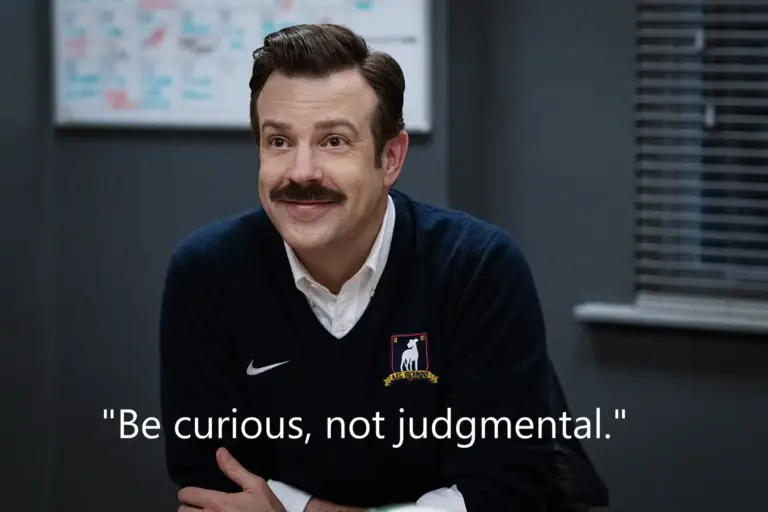
Photo: Ted quoting Walt Whitman in Ted Lasso, Season 1, Episode 8, “Diamond Dogs”, via AppleTV+
Be Curious, Not Judgmental
Let’s go back to the example of your friend being late for dinner. Do you have a right to be frustrated with your friend? Absolutely! Should you have a conversation with them about how their actions impact you? One hundred percent, yes. And it’s important to understand that something else might be happening here. If you curiously reflect on it, you might realize that you’re receiving the message, “I’m not important to them,” or “They don’t respect me.” This may not be a message that your friend intends to send, but it’s impacting you anyways (see Beth’s post on Intent vs. Impact).
If you dig even deeper, you might realize that the message of being unimportant is significant to you. Perhaps, growing up, your dad was so busy with work that he was perpetually late to your baseball games, orchestra concerts, etc. You felt unimportant back then, and that was a painful experience, especially connected to your parent(s). Now, when people are late, it’s a button for you – you make meaning about their lateness. You translate it into, “I’m not a priority to you; you don’t really care about me.”
Once we get curious about what’s happening, we can start looking beneath the surface for something else at play – the meaning that’s being made of the situation or content. This meaning might be tied to previous hurt from your relationship with the person who triggered the emotion. Or, this meaning might not even have anything to do with the person you’re fighting with! It’s possible that your big reaction is tied to previous hurt from childhood, past trauma, etc.
I’m not saying that every big feeling we have comes from something deeper. Sometimes, it’s as simple as having a lower capacity in the moment. Pro tip: Don’t have serious discussions when you’re Hungry, Angry, Lonely, or Tired (HALT). Regardless, having some curiosity about where the reaction is coming from can go a long way in resolving the conflict in front of you.
Time Travelling
I mentioned above that our feelings might not stem from the present moment. Often, when we get triggered, we “time-travel” back to when the related hurt first happened. Suddenly, I’m not responding to my partner’s justified anger because I forgot to do the dishes like he asked. Instead, I’m reacting to my grandfather’s huge, scary, explosive temper. Suddenly, I don’t feel like I’m a 34-year-old woman who’s emotionally mature. I feel like a 7-year-old little girl who’s terrified because her grandfather yelled at her and threw things across the room. For me in that moment, my past became the present.

Photo: The Doctor explaining how time is non-linear in Doctor Who, Season 3, Episode 10, “Blink”, via Disney+
When this happens, our brains can’t differentiate between what’s happening in front of us (the content) and what happened to us in our pasts that we’re trying to prevent from happening to us again (the meaning). This is another great time to pay attention to $500 reactions to 50¢ problems. It might cue us into these “past is present”, time-travelling moments.
How to Disrupt the Time-Travel
Differentiating between back then and right now can be incredibly helpful for emotional regulation! Firstly, allow yourself to come back into the present moment. If you’re in active conflict with someone, ask for a pause. Then, utilize some helpful grounding techniques, such as deep breathing, progressive muscle relaxation, or the 5-4-3-2-1 technique.
When you feel more present, validate your emotions. This is such an important step! Tell yourself, “It makes sense that I feel this way, because of what happened back then.” Give yourself permission to be upset. After you’ve felt the feelings, you might also say to yourself, “What happened back then isn’t happening now. This is a different situation.” It might take some time to regulate your emotions. Give yourself the space you need. Then, once you’re back in the “here and now”, you can re-engage in the discussion with your loved one.
Moving Forward with Content and Meaning
As with so many things, awareness is key. It’s important to understand for ourselves what meaning we’re making of a situation. And, for close relationships with safe people, it’s helpful for them to understand the meaning that we make of things, especially when it’s tied to big wounds from our pasts.
So, if you and your loved one are having a conflict about the same thing for the thousandth time, pause. Ask yourself: Does this conversation really mean what I think it means?
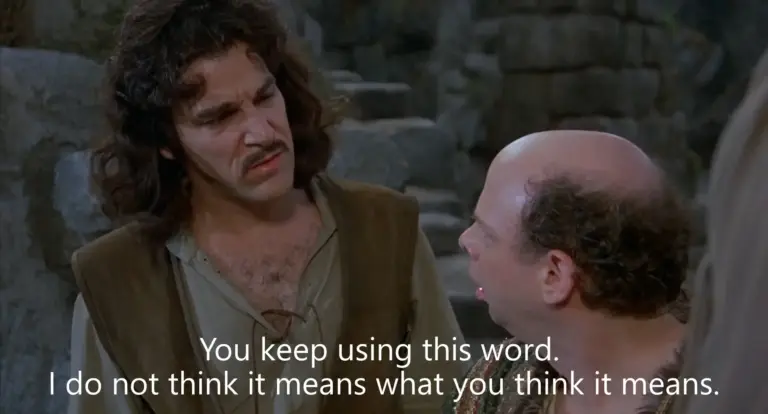
Photo: Inigo Montoya in The Princess Bride, via Disney+
If you discover a discrepancy between the situation and the reaction, lead with curiosity. The feelings are coming from somewhere real, even if it isn’t obvious at first. Then, use your emotional regulation skills to ground yourself in the present moment. Once you understand the meaning you’re making out of the content, validate yourself. Your emotions make sense! And finally, if the person you’re in conflict with is safe enough, have a conversation with them about what you’ve uncovered. In next month’s blog post, Karis will explore how to effectively communicate with your loved ones – stay tuned!
Want some guidance and support as you explore your meaning-making and time-travelling tendencies? One of our expert therapists would love to come alongside you.
Do you and your partner need an outside party to help you navigate the meaning you’re both making of your conflicts? Couples counseling might be a beneficial way forward.
Is your family stuck in cycles of conflict and underlying meaning-making? Our holistic approach to Whole Family Healing can help you understand each other more deeply.

Kiki Leonard, AMFT
Kiki Leonard brings passion and compassion to her role as a Marriage and Family Therapist Associate. She graduated from Richmont Graduate University with a Master’s degree in Clinical Mental Health Counseling and a Certificate in Marriage and Family Therapy. She is trained in Brainspotting, Internal Family Systems (parts work), Attachment-Based Family Therapy, and Emotionally Focused Therapy (Externship).
Kiki loves helping individuals and couples to heal and break free from unhealthy patterns. She also helps families grow closer and overcome obstacles through Waystone’s Whole Family Healing approach. In her spare time, Kiki enjoys reading, going to fan conventions, and doing aerial silks. She also loves spending time with her people as well as snuggling and playing with her dog.