
September 29, 2025 | Karis Rodila, LPC, LMFT
Communication is Key
We’ve all heard the saying, “Communication is key.” I know I heard it many, many times when I was getting married. It’s the guidance you almost always hear when you ask, “What’s your advice for a good marriage?” But what does this statement really mean? What makes communication healthy and effective in any relationship?

Communication is Hard
I want to acknowledge at the outset of this blog post that communication is difficult, as is communicating about communication. Plus, there is so much to say – I won’t be able to cover all that you need to know in one article. The aim of this blog post is to give you a 10,000-foot view of some of the skills needed to have healthier, more effective conversations.
Tools for Effective Communication
Be Curious, Not Judgmental
I’ll admit that I was a little late to the Ted Lasso bandwagon, but wow! Since I’ve watched it, it has quickly become one of my favorite shows. Now why am I bringing up Ted Lasso in a conversation about communication? Because of a scene in Season One where Ted says a profound line: “Be curious, not judgmental.” Walt Whitman was the first to say it, but I always hear it in Ted’s Kansas drawl.
Curiosity opens the conversation, while judgment is the surest way to shut everything down. When we feel judged by someone, we no longer feel safe to share the deeper parts of ourselves and our experiences. But when someone approaches us with curiosity, we have the space to open up, explore our experiences, and develop a stronger relationship with the other person. In the same way, our curiosity towards others helps us to be more emotionally regulated and protected against all-or-nothing thinking.
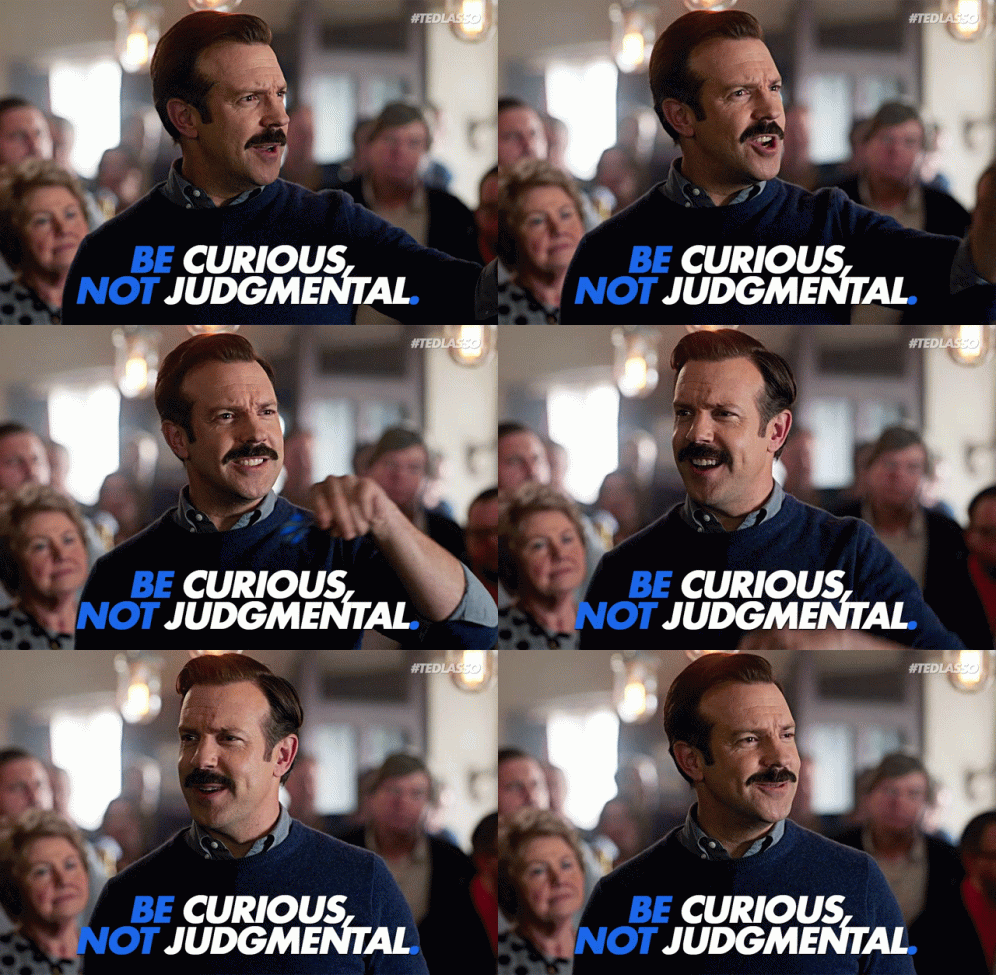
GIF: Ted quoting Walt Whitman in Ted Lasso, Season 1, Episode 8, “Diamond Dogs”, via AppleTV+
Curiosity in Action
Say a friend isn’t as responsive or engaged as they typically are. If I were in a judgmental place, I could make the meaning that I did something wrong and they’re mad at me. Or I could blame them, thinking that they are a bad friend. However, when I am seeking to practice curiosity, I like the phrase: “I noticed ______, and I wonder ______?” That could look like: “I noticed that my friend isn’t responding like they normally do. I wonder if there is something going on for them that’s getting in the way of their ability to be present with me?”
From this perspective, I can then approach that friend from a calm, compassionate, and curious place. If you dig even deeper, you might realize that the message of being unimportant is significant to you. Perhaps, growing up, your dad was so busy with work that he was perpetually late to your baseball games, orchestra concerts, etc. You felt unimportant back then, and that was a painful experience, especially connected to your parent(s). Now, when people are late, it’s a button for you – you make meaning about their lateness. You translate it into, “I’m not a priority to you; you don’t really care about me.”
Clear is Kind
My friend and I constantly tell each other, “Clear is kind.” This phrase means that we intend to be direct and explicit in expressing our feelings, experiences, and needs. In other words, we say what we mean and mean what we say. Being clear and direct ensures that we don’t fill in the gaps with our own assumptions. This helps to cut down on miscommunication and grows trust as we are transparent with each other.
Healthy, “clear is kind” communication looks like assertiveness. Assertiveness is the ability to calmly and confidently state your opinion, belief, want, need, or experience. It is an empowered stance where you honor your thoughts, feelings, and needs. Bonus: it also gives the other person the best chance to understand your experience and meet your needs to the best of their ability.
Passive, Passive-aggressive, and Aggressive vs. Assertive Communication
Unhealthy types of communication include passivity, passive-aggression, and aggression. When speaking aggressively, volume, tone, and the words chosen are meant to scare or force someone into agreement. Passive and passive-aggressive communication are both forms of indirect communication regarding your negative feelings or experiences. Passive communication often means a lack of talking about your feelings, experiences, or needs. This leads to a lack of authenticity. It could also be indicative of conflict avoidance or people-pleasing tendencies. With passive-aggressive communication, you might be trying to manipulate the other person into complying without being direct about your wants and needs.

For example, say I wanted a friend or partner to prioritize time with me. However, I verbally lashed out and demanded that they change their behavior. With this approach, I am doing damage to the relationship. Conversely, if I use “the silent treatment” or passive-aggressive comments about the lack of time together, I am unlikely to get the response I desire. Why? Because the other person has little to no idea what’s wrong!
If I am clear and assertive about my desire for time together, I am more likely to receive the response I want. Assertiveness can look like, “I’ve been feeling a bit disconnected in our relationship recently, and I would like to spend more time with you. Could we take a few minutes to find a time that works for both of us and plan an outing together?”
“Cue” Them In
Another tool that I really love when it comes to effective communication is the use of cue words or phrases. A cue word or phrase allows a lot of meaning without having to say or explain too much. They are most effective when both people have discussed what the cue is and its meaning during a time of calm. This way, both parties are on the same page when the cue is called during more heated moments. Some examples of cues that I use with clients are:
- “Pause,” meaning: “I am getting reactive and don’t want to show up in hurtful, unhealthy ways. So instead of continuing to talk, I am asking us to stop before damage is done. Let’s take a little while to take care of our hearts so our conversation will be productive later. I am committing to talking again later.”
- “This is what my brain is telling me,” meaning: “I am feeling a little triggered right now and am having unrealistic thoughts about this situation. I know it isn’t true, and I need some reassurance/explanation of what was going on for you.”
- “Oklahoma” (Another Ted Lasso reference, anyone?), meaning: “I want to hear the God’s honest truth from you.” (First seen in Season 1, Episode 5.)
A cue word or phrase can literally be anything as long as both people understand the meaning behind it. I believe that humor is a significant healing factor and emotional regulation skill, so get a little silly with your cues! It can reduce the tension and allow for better communication going forward.
Know Thyself
Effective communication comes from an awareness of yourself: what you are feeling, thinking, want, and need. Seek to practice awareness of your experience. Own your part of the conflict or what is in your power and control in the relationship. And, attend to your feelings. If you can process your feelings and experiences in healthy ways, you will be more able to communicate from a regulated and empowered place. A handout like The Five A’s can help you process your heart prior to communicating your feelings and experiences to someone else.

“Line, please?”
Don’t you wish there was a script for life sometimes? That when we feel stuck or unsure we could call out, “Line, please?” and someone off to the side will helpfully fill in what we should say next? It can often feel like we don’t know how to express ourselves in a way that will be understood. This is why having a formula, like the Speaker Listener Formula, can be so helpful. It gives us the structure we sometimes need to effectively communicate what we are thinking, feeling, and experiencing.
To use this “script” most effectively, you must first make sure that you are in a regulated place. You can use breathing techniques like box breathing or 4-7-8 breathing to calm your body and brain. The next step is to process what your responsibility is in the current conflict or conversation. Then you can reflect on your experience of the conflict/conversation and formulate what you want to communicate to the other person about said experience.
Here's a Simple Script:
“I felt ___(insert emotion/ feeling word)___ when or about ___(the situation)___, because the message I received was _____. And I know that’s not your heart. Can you help me understand so we can work together on a solution to this conflict?”
So, going back to our earlier example about the friend who has been distant, here’s how I would communicate about that experience:
“Hey! Is now a good time to talk about something I’ve been experiencing in our friendship? I felt distant and sad when I perceived you not being as responsive as you typically are, because the message I received was that I’m not important to you. And I know that’s not your heart. Can you please help me understand what’s been happening for you recently?”
Notice that in my example, I’m using “I statements.” This is a way of giving the benefit of the doubt that my perception might not match the other person’s experience. Acknowledging this can help them not be defensive from the start of the conversation. It is also owning my feelings and experiences without blaming or shaming the other person.
Now, it’s going to feel weird and maybe robotic to talk this way at first. But keep at it! It will get more natural with time, and you’ll see your communication improve.

Be Active! (In Your Listening)
Make sure that after expressing your thoughts, feelings, and experiences, you leave room for the other person to share theirs. Our goal in communicating anything is to be heard and understood. And our goal in listening is to understand the other person, not to prepare our responses. When listening to understand, it’s helpful to practice curiosity by looking for the deeper emotions underneath the content.
In therapy, we use what’s called “active listening,” which is a way of summarizing and reflecting what you heard the other person say in your own words. You don’t want to “parrot back” word-for-word what they said. Sometimes the same words mean different things to different people. So, reflecting what you heard in your language can highlight if your understanding is different from the message they meant to send. When it becomes apparent that you haven’t quite “got it”, you have the opportunity to try again and clarify further. In this way, active listening gives the opportunity to “check your work” so to speak.
Continuing with our example above, my friend could reflect:
“What I heard you say is that you’ve felt distance from me because I haven’t responded as quickly as usual, and it made you think that I didn’t value you and our friendship. Am I understanding that correctly?”
This response shows that my friend was actively listening to me and is curious about my deeper experience, not just the content I’m giving them. From here, we can better understand each other and work together towards a solution that leads to more connection.
A Final Word
The topic of communication is difficult, complex, and broad. These suggestions aren’t going to fix all the communication struggles you may have in your life, but this blog post is a great starting place! If you would like more assistance with healthy communication, consider viewing the resources below or talking to a therapist.
This detailed explanation of the Speaker-Listener Formula outlines important steps and tips for how to express yourself as well as how to listen effectively.
The 5 As are a helpful guide for exploring and processing your experiences, contributions to conflict, and your feelings, along with helpful next steps for conflict resolution.
If you recognize that communication struggles are a part of your life and relationships, consider talking to your therapist about other tools and techniques that could help.

Karis Rodila, LPC, LMFT
Karis Rodila studied psychology at Berry College and received her Master’s in Marriage and Family Therapy from Richmont Graduate University. She specializes in working with adolescents (16+) and adults navigating different life circumstances like trauma, anxiety, depression, life transitions, relationship challenges, and more. Karis works with individuals as well as couples, and she is passionate about coming alongside her clients to help them discover their personal power. In her free time, she enjoys drinking coffee, spending time with her friends, and reading books by her favorite author, Brandon Sanderson. Disclaimer: If you ask her about Sanderson, be prepared for a lengthy and impassioned conversation!